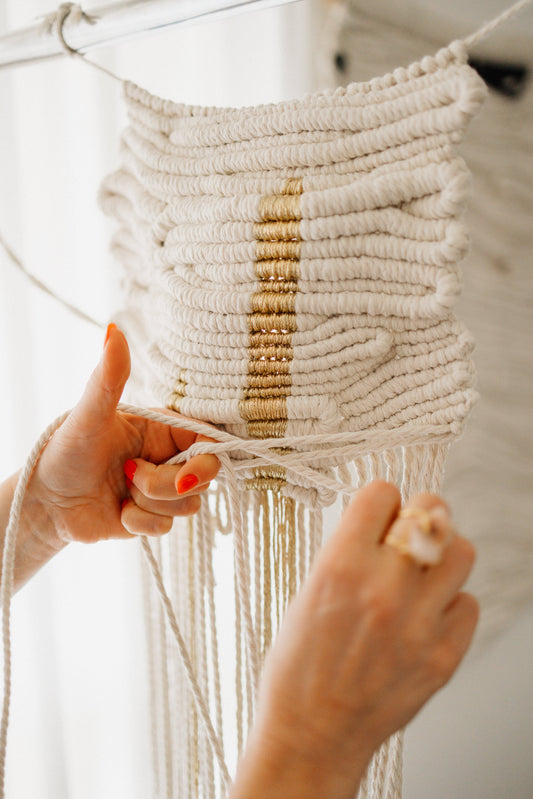

Why we're craving texture, craftsmanship and the human hand in an increasingly digital world
If you've been here for a while, you'll know that my work has always revolved around rope, repetition and the quiet language of texture. What you may not know, however, is that alongside my art practice lives another fascination—one that has been quietly shaping the way I think about making for years.
I'm endlessly captivated by interior design.
Not in the sense of collecting paint swatches or following the latest trends, but by the rare ability some people have to create spaces that change the way you feel the moment you walk through the door. The kind of interiors that seem to lower your shoulders without asking permission. Spaces that feel warm without relying on clichés, sophisticated without feeling precious, and somehow manage to hold both restraint and personality at once. They don't simply look beautiful. They become places you want to linger in.
I've often wondered what separates those spaces from all the others.
The more projects I found myself saving—from studios like YSG, Flack Studio, Simone Haag and Hans Lorei—the more I realised they all seemed to share something remarkably similar. Of course, their aesthetics differ, but beneath the surface they are all speaking the same language. They value craftsmanship over novelty, materiality over perfection, and story over spectacle. They create interiors that feel deeply considered, where every object earns its place and every surface invites a different kind of attention.
At first, I thought I was simply drawn to good design. But over time it became clear that I wasn't admiring individual projects as much as I was observing a much larger shift in the way we are choosing to live.
Without really noticing, we've started surrounding ourselves with things that feel unmistakably human.
Timber that still carries the memory of the tree it came from. Stone whose imperfections are celebrated rather than hidden. Hand-thrown ceramics that refuse to be identical. Vintage furniture that arrives with a history already attached. Sculptural lighting made by independent makers. Textile works whose surfaces reveal hours, days, sometimes months of someone's quiet labour.
The more I paid attention, the more I realised this wasn't a passing aesthetic trend. It felt like a collective instinct.
And that question has refused to leave me ever since.
Why, at a time when technology allows us to produce almost anything faster, smoother and more efficiently than ever before, are we becoming increasingly drawn to objects that are slow, tactile and unapologetically handmade?
Because I don't think this is nostalgia.
Nor do I think it's a rejection of technology. I love what technology has made possible. It's allowed me to connect with collectors on the other side of the world, to discover artists I may never have encountered otherwise, and to build a practice from a small regional studio in ways that simply weren't possible a decade ago.
But our bodies haven't evolved at the same pace as our devices.
Most of us spend our days moving between screens, touching little more than smooth glass and polished plastic. We scroll through hundreds of images before breakfast, absorb more information than any generation before us, and spend much of our working lives inhabiting digital spaces rather than physical ones. Our eyes are constantly stimulated, yet our sense of touch has become strangely underused.
Perhaps that's why texture feels different now.
Perhaps it isn't simply something we admire.
Perhaps it's something we need.
That thought has quietly become the foundation of my own practice.
When I begin a new work, I don't start with a finished image in mind. I begin with a question, an emotion, or a feeling I can't quite articulate. The work emerges through thousands of repeated hand-knotting gestures, one after another, over weeks and sometimes months. It is slow by necessity, but also by choice. Somewhere within that repetition, the work reveals itself, and so do I.
Only recently have I realised that my practice has been circling the same question all along.
Not, what can I make?
But rather, what does the human hand still offer that nothing else can?
I don't think people respond to my work because of the knotting itself.
I think they respond to what the knotting represents.
Time.
Attention.
Care.
The visible record of a person choosing, over and over again, to stay with something until it comes into being.
This is why I've started calling this series Things Our Bodies Already Knew.
Because I have a feeling our attraction to texture, craftsmanship and handmade objects isn't new at all.
Perhaps it's simply something we've remembered.